In early November 2026, following the launch of Bambu Lab's nine-toolhead H3C, the 3D-printing community began discussing multi-color, multi-toolhead FDM printers and their competing architectures. With every manufacturer promoting new products, which one is right for you? After hands-on testing, it was difficult to choose an outright winner: each had distinct strengths. A video appears at the end of the original article.
On November 6, Nanjixiong invited experienced 3D-printing users to conduct hands-on unboxings and reviews of four recently launched machines: Bambu Lab H3C (nine heads), Creality K3 (four heads), Creality i8 (one head with fast four-color switching), and the latest QIDI U1 (four heads).
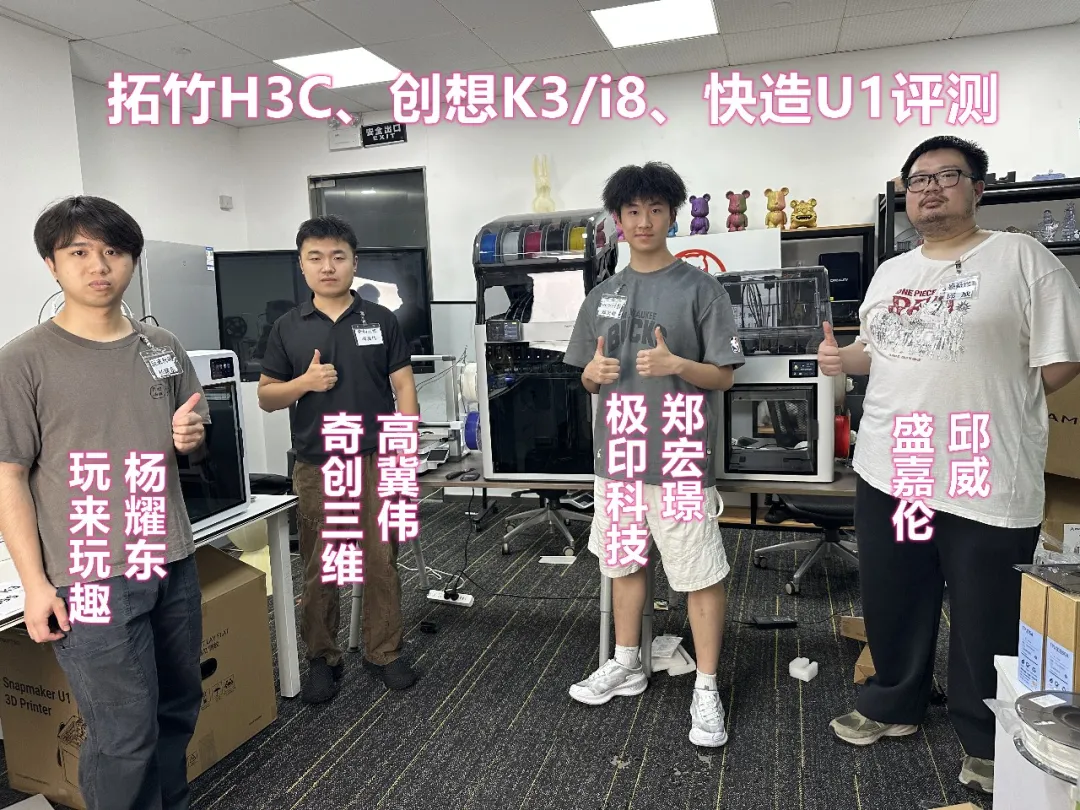
△ Thanks to the four reviewers who attended
The guests were Yang Yaodong, CEO of Wanlai Wan Qu, who started a 3D-printing farm while at university; Gao Jiwei, CEO of Qichuang 3D, who runs 3D-printing training and design-application programs; Zheng Hongjing, CEO of Jijin Technology, owner of Dongguan's first 3D-printing experience store, and a university-era 3D-printing-farm founder; and Qiu Wei, head of Shengjialun's 3D-printing materials test center and a specialist in TPE materials.
Instead of the familiar multicolor benchy, the team printed an AI-generated “Nanjixiong” model: four colors on the Creality K3/i8 and QIDI U1, and eight colors on the Bambu Lab H3C. The model was not manually repaired.
1. Unexpected moments during the review
1. The AI-generated Nanjixiong looked striking, and all four printers completed the job. Bambu Lab H3C and Creality i8 were fastest, but total print times across the machines were around 7.5–9.5 hours.
2. During the first few layers on the H3C, “Ludicrous” mode caused slight warping and poor adhesion. Reprinting in Standard mode at 100% speed fixed the problem. After layer 20, the team switched back to Ludicrous mode at 165% speed, but one support shook loose. They returned to Standard mode; even with one support missing, the print still succeeded. The H3C printed the Nanjixiong in eight colors by blending five materials, taking about eight hours—similar to the other three printers, which printed only four colors. In this analogy, the H3C took a college-entrance-exam paper while the others took a high-school-entrance-exam paper, yet all scored about 90%. The H3C's performance was particularly impressive.
2. Technical and performance comparison
Bambu Lab H3C
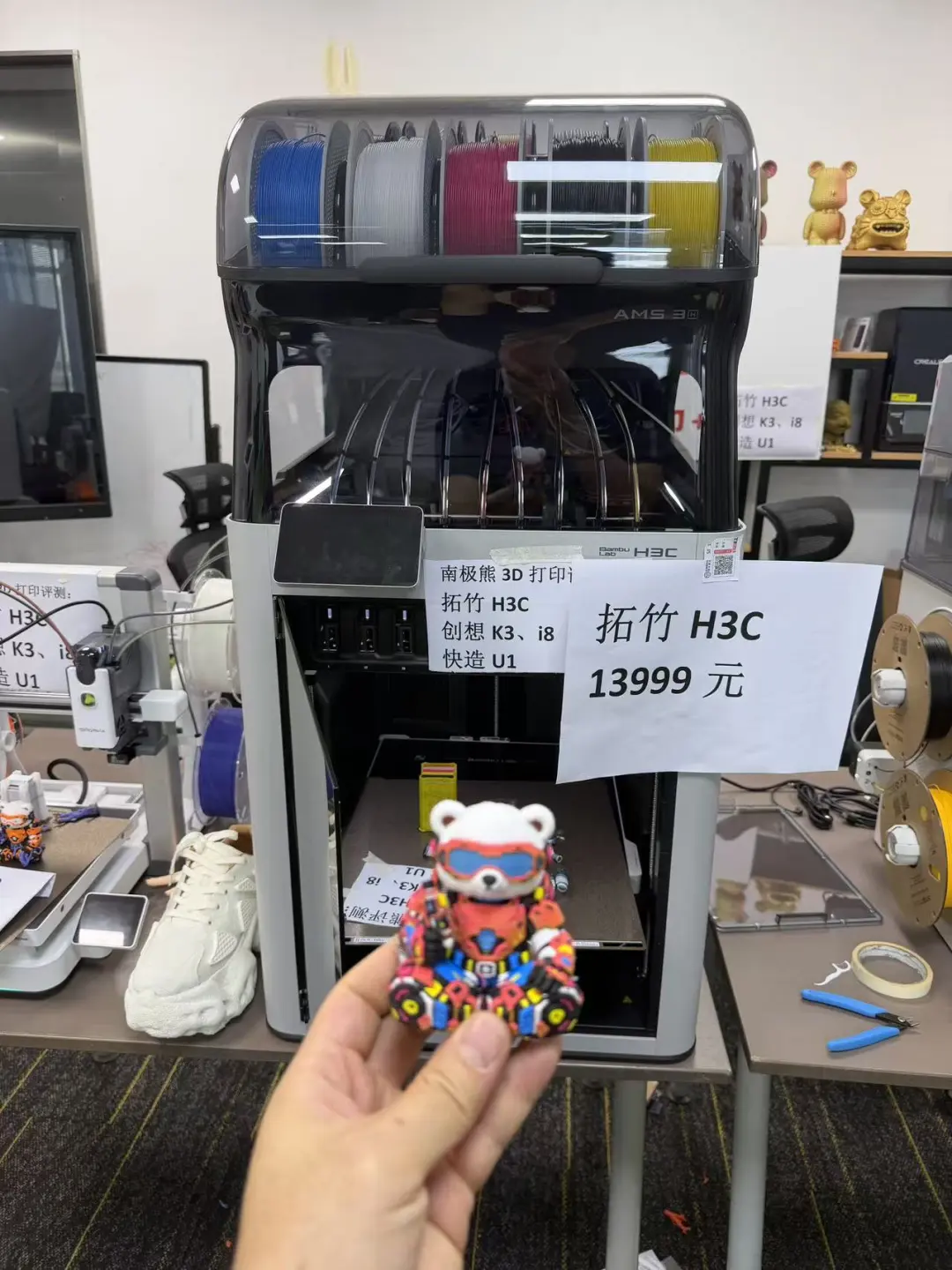
The system combines nine toolheads, the Swaptek multi-head rapid-switching system, an integrated top-mounted AMS 3H material feeder, and variable-diameter extrusion. Each head has an independent filament path and heater, and filament stays loaded. Switching directly changes heads without retraction or purging. The advertised tool-change time is under six seconds, with about 38 mg of waste per material change. One head is dedicated to 2.85 mm, 75A ultra-soft TPU, enabling printing with both rigid and flexible materials. This is one of the consumer systems with the most tools and the most complete material separation.
- Nine heads: eight for 1.75 mm filament and one for 2.85 mm filament, especially suitable for soft TPU/TPE.
- The system can rapidly switch not only printheads but also tools such as cutting heads and brushes.
- Variable-diameter extrusion supports both 1.75 mm and 2.85 mm.
- Acceleration up to 25,000 mm/s² and print speed up to 1,400 mm/s.
- Color and material changes take under six seconds; the physical head-switching motion takes 3.4 seconds, aided by independent preheating.
- Supports mixing 0.2, 0.4, 0.6, and 0.8 mm nozzles in one print.
- Can expand to 24 colors by connecting a four-in-one adapter to one port and adding 16 spools (8 + 16 = 24).
- Blends five base colors into more than 180 colors and supports gradients.
Creality K3
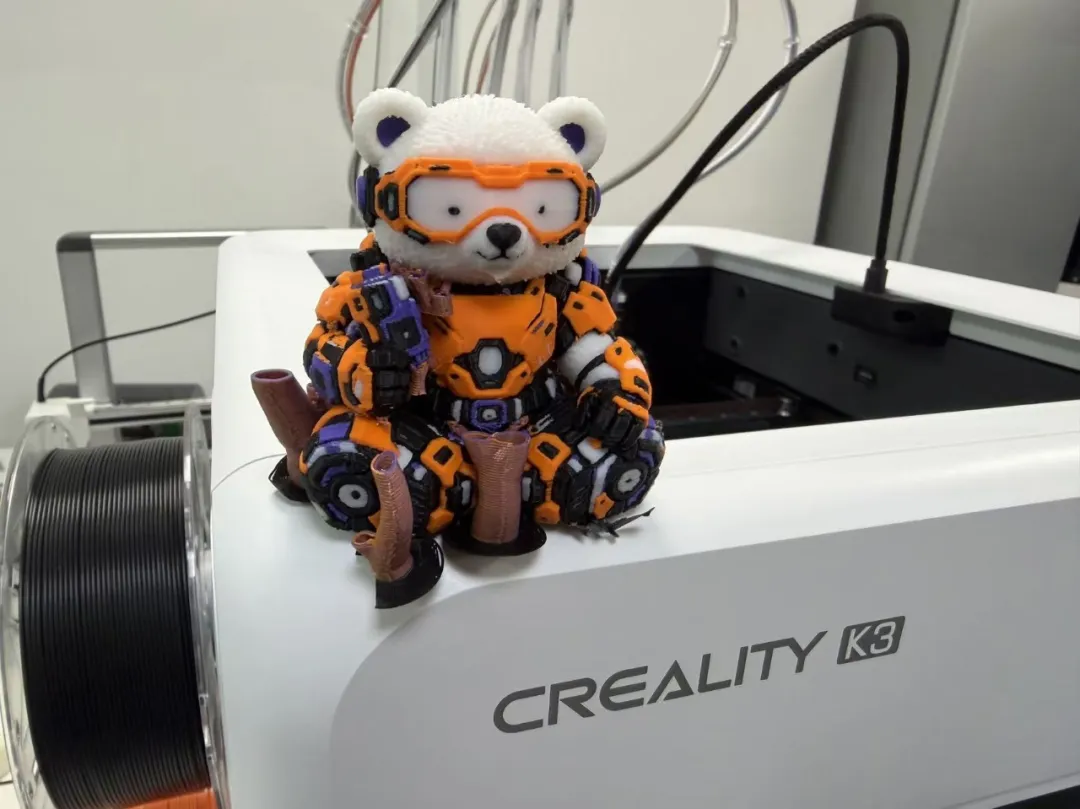
It changes nozzles without changing the printhead. KliTek™ uses four independent nozzles; only the nozzle assembly changes during a color switch. The advertised switch time is about five seconds, with no filament retraction or purging. A distinctive feature is mixing nozzle diameters—for example, a 0.2 mm nozzle for detail and a 0.8 mm nozzle for infill—although the multi-diameter kit is sold separately. This simplifies color changes to changing the tool end, though the four nozzles share some motion structure.
Creality i8 (SPARKX i8)
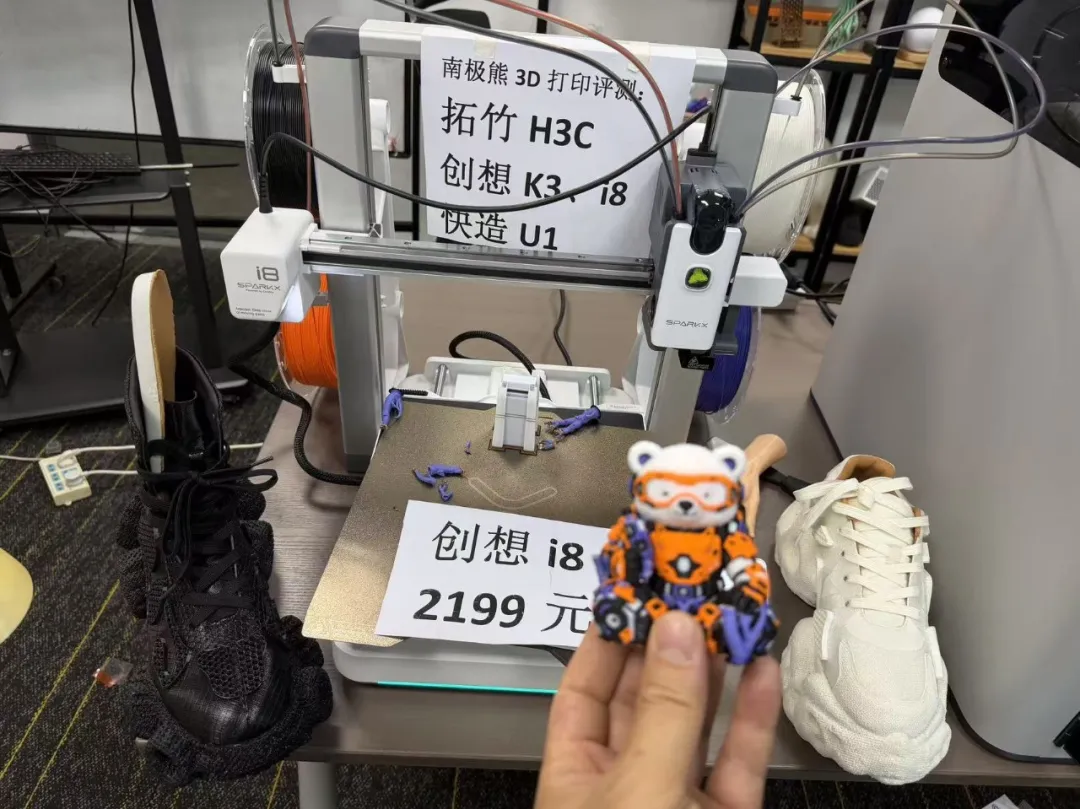
It uses a single nozzle and hot end with four filament paths compressed into a shared path less than 1 mm long, using QuarTeks technology. It is the most lightweight architecture of the four. The printhead selects a channel internally, with a claimed color-change time under one second, the fastest of the group. The very short shared path sharply reduces purge waste. With a specific algorithm, “zero waste” printing is possible—not literally no material extrusion, but some purged material can be used as model infill. All four colors still share the same melt chamber and nozzle.
QIDI U1
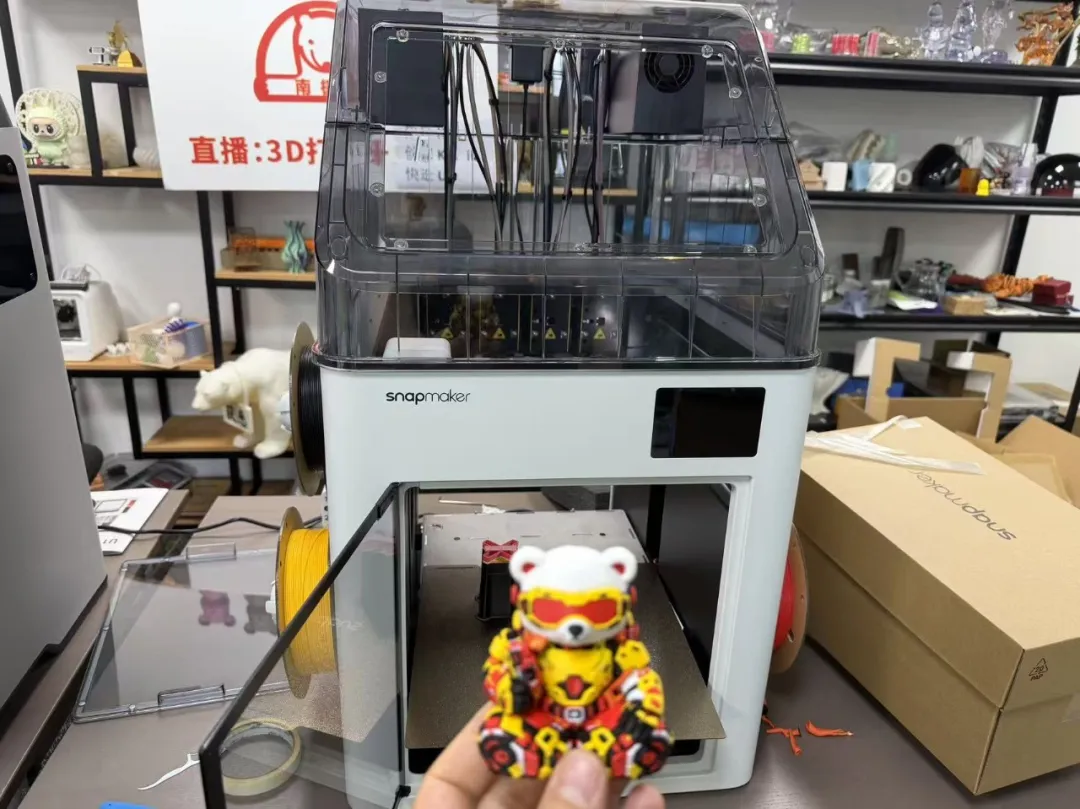
It has four independent, complete toolheads, switching the entire head to change color. The advertised switch time is five seconds, using a steel-ball locating coupling. Each color/material has a separate nozzle and filament path, without a shared melt zone.
3. What can the review tell buyers?
The manufacturers' technical specifications and performance figures appear generally accurate. Beyond slicer usability, model-library depth, and human-machine interaction, buyers should consider other factors. There is no universally best choice—only the best fit for a user's needs.
Price
- Bambu Lab H3C: about RMB 14,000 in China as a bundle; more than RMB 20,000 overseas.
- QIDI U1: about RMB 4,500 as a standalone machine; Double 11 bundle price around RMB 4,400–4,928.
- Creality i8: crowdfunding and retail prices around RMB 2,200, about half the price of comparable four-color machines.
- Creality K3: about RMB 4,600, similar to the U1.
Space and installation
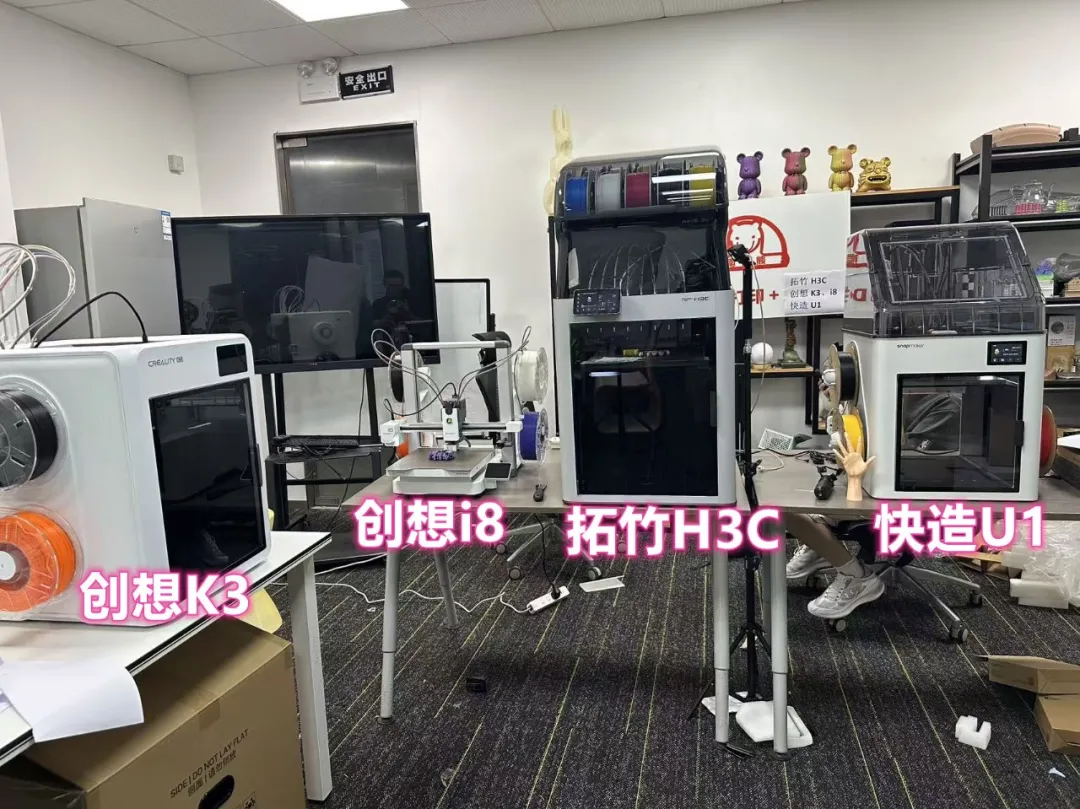
The machines have very different external dimensions, as shown in the first photo. The Creality i8 is the smallest and looks like a child beside the H3C. The U1 and K3 are similar in size. The H3C requires enough floor space and ceiling height.
Number of colors and materials
The Bambu Lab H3C has nine variable-diameter heads, supports rigid and flexible materials and different filament diameters, and has a comparatively advanced software feature set; it offers the broadest compatibility. Because the Creality i8 has one printhead, it is suitable only for printing one material family at a time, such as different colors of PLA. The QIDI U1's four independent heads have been widely validated for stable rigid/flexible multi-material printing over long jobs, with tens of thousands of units verified in 3D-printing farms. The Creality K3 has four independent nozzles, and the company plans upgraded head/nozzle kits supporting multiple nozzle sizes and rigid/flexible materials.
4. Video from the hands-on test
The original article strongly recommends watching the on-site review video: it is fun, candid, and perhaps a little chaotic rather than polished—and the H3C nearly went off track during the test. The full session ran nine hours, much of it showing printers building models. A replay is available on Nanjixiong's video channel, and the article includes a shorter edited version.
△ Review video excerpt
AI-translated from an article by Xiaoruanxiong on Nanjixiong, originally published on 2026-11-09. Text and images retain the original source attribution.
Read the original Chinese article |



 Record number | ©2024 panda3dp Team. Powered by panda3dp