Source: People's Daily
A simple meal is routine for most people, but for older adults with reduced swallowing function, every bite requires special care. A moment's inattention can cause choking; in severe cases, food may be aspirated into the trachea.
Declining swallowing function makes eating a burden and can lead to inadequate protein intake and muscle loss. Aspiration pneumonia is also a common, potentially fatal risk for elderly people.
Most "special medical-purpose foods" available today are pastes or purees. While they can reduce some choking risks, they are often nutritionally limited, visually indistinct and bland. Balancing nutrition, taste and safety remains a challenge.
To address these issues, an innovation team in food nutrition and functional foods at the Institute of Food Science and Technology, Chinese Academy of Agricultural Sciences, recently used a dual-protein composite modification strategy to create a composite emulsion-gel system from walnut protein and egg-white protein. Using extrusion-based 3D printing, the team developed a high-protein, easy-to-swallow biomimetic salmon food.
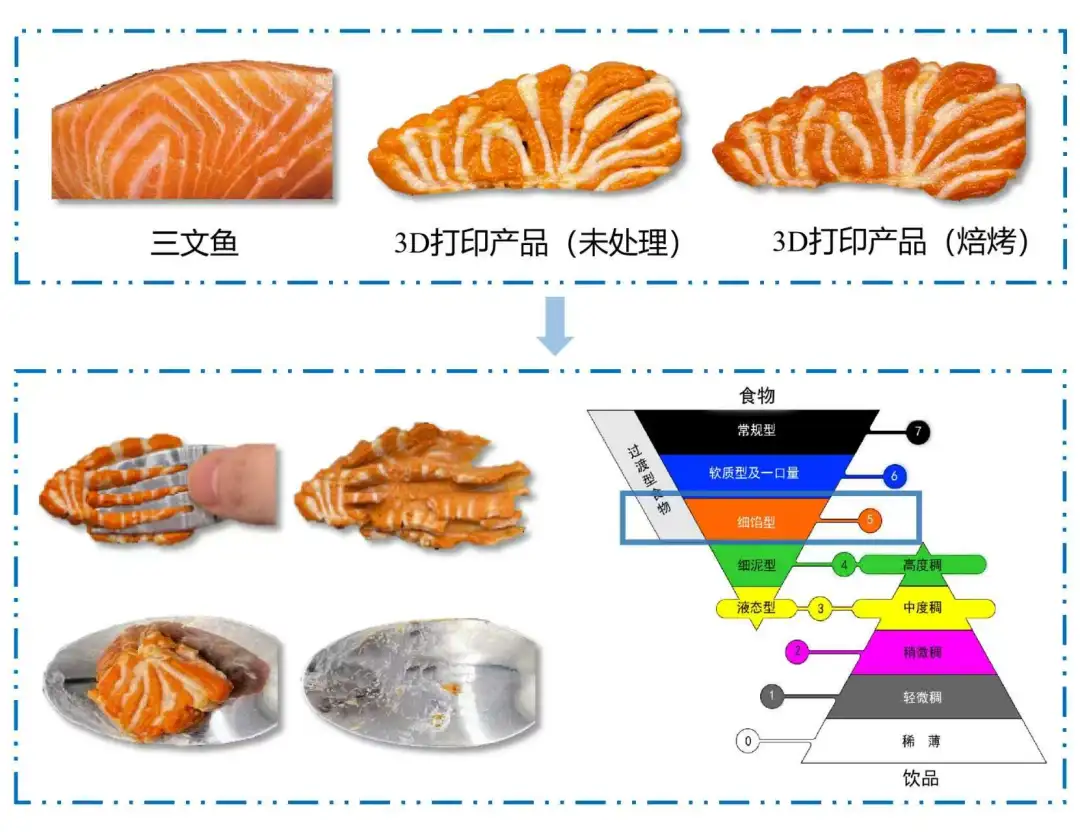
△ Illustration of 3D food-printed salmon
Precision "printing" starts with the "ink"
The key advantage of 3D food printing is that it can precisely construct the shape and structure of food according to a design. The key to this detailed process is the printing "ink."
The research team used a composite "dual-protein" strategy. Walnut meal, a byproduct of walnut oil production, contains up to 45% protein and is a high-quality plant-protein source, but it has weak gel-forming ability and is difficult to print into shape. The researchers introduced egg-white protein, which readily forms a stable gel network. It acts like a fine "skeleton" into which the walnut protein is incorporated.
With a dual-feed 3D printer, two differently colored protein "inks" are extruded simultaneously: yellow walnut protein–egg-white protein to simulate muscle and white soy protein isolate–egg-white protein to simulate fat. Together they accurately reproduce salmon's characteristic red-and-white pattern.
Baked or steamed? The flavor test decides
The researchers compared steaming and baking. They found that baking significantly increased key flavor compounds, and produced better color, aroma and swallowing smoothness. Baking at 100°C for 3 minutes was the best-performing method and received the highest sensory score. Adjusting baking time can precisely control softness, producing food at Levels 5 and 6 of the international dysphagia food standard for older adults with different swallowing abilities.
Professional testing found that the biomimetic salmon contains 22% protein. It is soft and moist, forms a cohesive mass and does not readily fall apart, meeting texture requirements for safe swallowing.
Nutritious, safe and tasty
The potential of this technology goes well beyond its initial application. It efficiently supplies high-quality protein: protein supplementation efficiency is 200% higher than that of traditional products and can help older adults maintain muscle mass more effectively. The approach also goes beyond the limitations of conventional molding. By modifying protein structure and using multidimensional additive manufacturing, it can precisely create soft foods spanning IDDSI Levels 4–6, providing tiered solutions for people with different degrees of dysphagia.
In the future, meals could be individually "printed" for older adults with different swallowing levels, nutritional needs and taste preferences. Protein content, nutrient ratios, flavor and texture could all be adjusted by changing the "ink" formulation and printing parameters.
As the technology matures and production costs are controlled, these biomimetic foods could gradually enter elder-care facilities and ordinary homes, helping people with swallowing difficulties eat safely, nutritiously and with enjoyment.
AI-translated from an article by Beijixiong on Nanjixiong, originally published on 2026-10-19. Text and images retain the original source attribution.
Read the original Chinese article
Cross-posted copies of the same source content have been consolidated into this article. |



 Record number | ©2024 panda3dp Team. Powered by panda3dp