Nanjixiong introduction: The era of one company hoarding all the business is long gone. Today's 3D printing service sector operates through a pack strategy.
On October 17, 2026, in Dongguan, Nanjixiong was invited to the opening ceremony of a new factory belonging to Dongguan Leishi 3D.
Walking into the new factory, the first thing in view was not the hammering of a traditional manual workshop, but rows of large industrial 3D printers. The new factory currently has more than 200 industrial 3D printers installed, and Leishi 3D plans to expand that number to 500.
But what impressed Nanjixiong even more than the machines were the greetings from industry peers displayed in the office building and the dinner that evening.
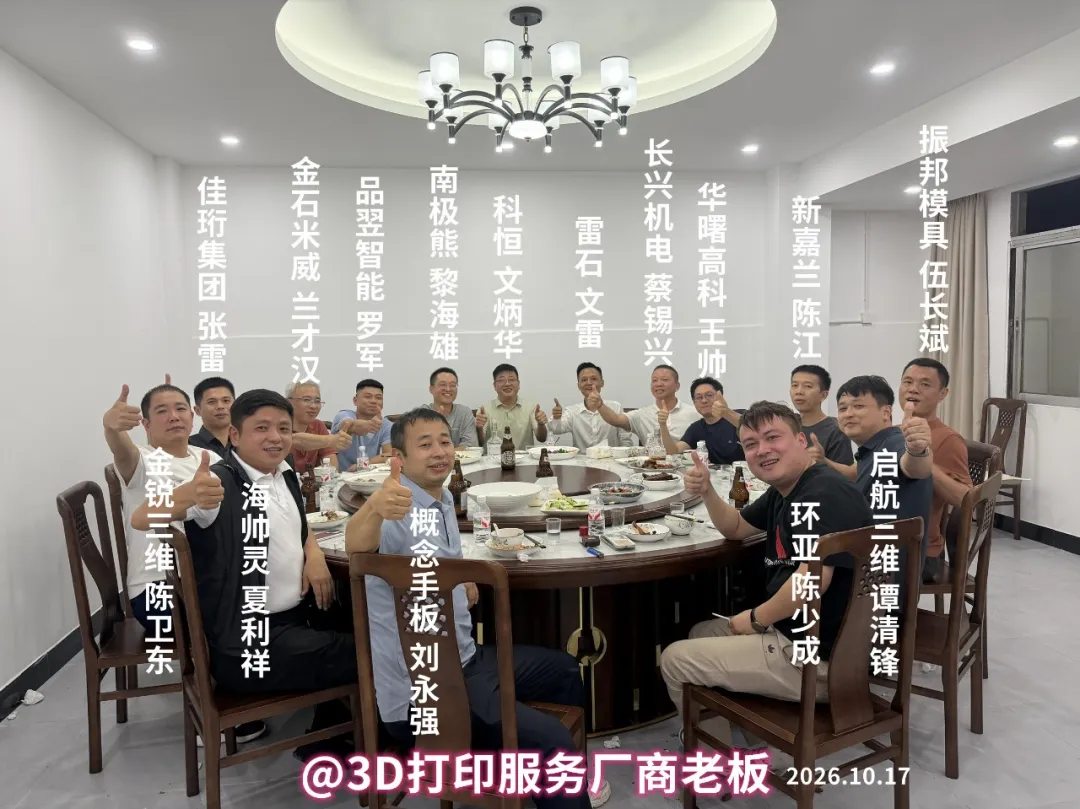
△ A tableful of 3D printing service company owners
Nanjixiong had the good fortune to sit with a group of domestic 3D printing service owners—most of them business owners, with a few exceptions such as Nanjixiong. If listed, the names at the table would cover a substantial part of the photopolymerization service sector in South and East China:
Dongguan Keheng Prototype Model Co., Ltd. — Wen Binghua
Dongguan Leishi 3D Printing Technology Co., Ltd. — Wen Lei
Zhejiang Jiaheng Intelligent Equipment Manufacturing Co., Ltd. — Zhang Lei
Ningbo Jinrui 3D Printing Technology Co., Ltd. — Chen Weidong
Dongguan Huanya Model Technology Co., Ltd. — Chen Shaocheng
Dongguan Xinjialan Model Technology Co., Ltd. — Chen Jiang
Yuyao Haishailing Model Co., Ltd. — Xia Lixiang
Yuyao Concept Prototype Model — Liu Yongqiang
Shenzhen Qihang 3D Model Technology Co., Ltd. — Tan Qingfeng
Hunan Farsoon High-Tech Co., Ltd. — Wang Shuai
Guangdong Miwei Intelligent Equipment Co., Ltd. — Wang Caihan
Dongguan Zhenbang Mold Materials Co., Ltd. — Wu Changbin
Dongguan Changxing Electromechanical Technology Co., Ltd. — Cai Xixing
Guangdong Pinyi Intelligent — Luo Jun
Nanjixiong 3D Printing Network — Li Haixiong
There was no mutual wariness or withholding of information. Although they compete in normal circumstances, they cooperate and allocate work to each other when large orders arrive, growing the overall market together. This open, communicative and convivial atmosphere is precisely a sign that China's 3D printing service market is maturing.
The "Dongguan dinner" of 3D printing services: cooperation matters more than competition
Many people assume competitors glare at each other when they meet, especially in a 3D printing service sector caught up in price wars.
But over dinner, Nanjixiong sensed a different atmosphere. Prototype model makers, intelligent equipment companies, mold-material suppliers and upstream equipment companies sat together, discussing industry trends and building relationships over drinks.
3D printing services are a capital-intensive, delivery-intensive business. A single large machine can cost hundreds of thousands or even millions of yuan. When urgent or large orders arrive, any company's capacity can suddenly become tight. What can they do? Share machine time and outsource work to one another. This trust-based cooperation reduces the risks of expansion and ensures a better delivery experience for end customers.
The dinner was a miniature of China's "trillion-yuan" 3D printing services market. Companies are no longer isolated workshop owners but partners in an industrial cluster.
Nanjixiong commentary
Over the past few years, many people entered 3D printing services by buying a few machines and opening a shop. By 2026, that model has run its course.
Why? Downstream demand has changed. Whether for new-energy vehicle prototypes, consumer electronics prototypes or cultural and creative products produced in batches, customers want not only parts that can be printed, but also extremely fast delivery and the lowest possible cost.
The open-minded attitude of the owners at this table matters. Competition in 3D printing services has moved beyond a race to the lowest price and entered a second phase of competing on supply chains and ecosystems. When competitors stop being enemies and become allies who can redistribute capacity, China's industrial 3D printing applications can expand much more quickly.
AI-translated from an article by Xiaoruanxiong on Nanjixiong, originally published on 2026-10-19. Text and images retain the original source attribution.
Read the original Chinese article |


 Record number | ©2024 panda3dp Team. Powered by panda3dp