Introduction
Much of the attention in metal 3D printing has centered on parts smaller than a meter, with some large parts reaching the 2-meter class. How can structures larger than 10 meters be made? In late October 2026, Professor Liu Changmeng's team at Beijing Institute of Technology (BIT) published work on meter-scale titanium-alloy single crystals in Nature and announced an angel round worth tens of millions of yuan.
On October 26, 2026, Nanjixiong learned that Juxing Intelligent Manufacturing (Beijing) Technology Development Co., Ltd., which focuses on ultra-large metal additive manufacturing, completed an angel financing round worth tens of millions of yuan. Guoding Capital and Yunshi Capital invested jointly. Funding will support assembly of the core team, R&D of ultra-large metal AM equipment, and commercialization. The company was founded in April 2026 by the team of Liu Changmeng, professor and doctoral supervisor at BIT's School of Mechanical Engineering, as a commercialization platform for original work by BIT's cross-scale additive manufacturing team.
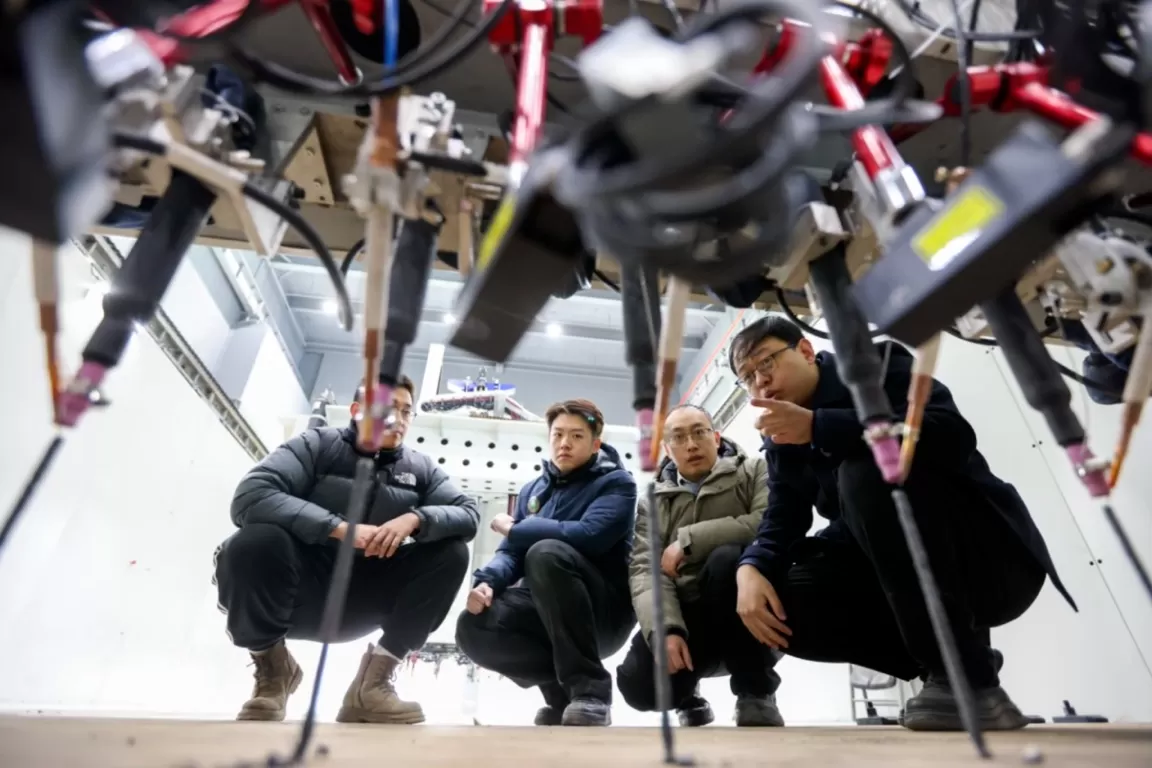
△ Professor Liu Changmeng (first from right)
The financing and the team's progress
According to PEdaily, the company is accelerating the formation of a team spanning equipment R&D, process development, production, and marketing. Construction of a Tianjin production base is progressing alongside iterative development of ultra-large equipment, while classification-society certification has entered a key stage.
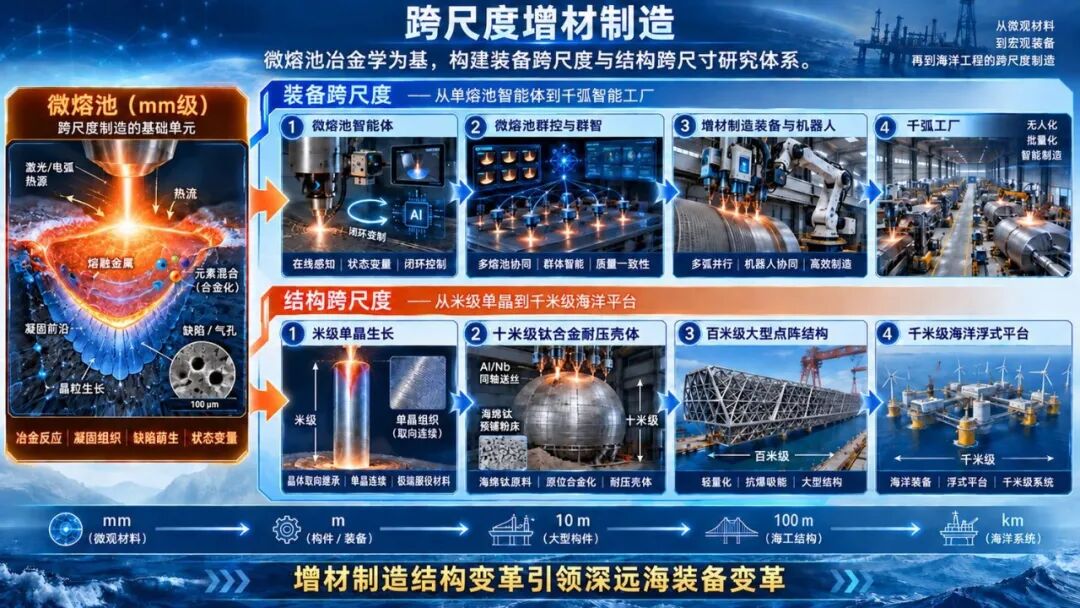
Why focus on very large structures? The company says metal additive manufacturing at industrial scale currently concentrates on small and medium-sized structures under one meter. Mature manufacturing methods remain lacking for structures larger than 10 meters in marine and energy applications. Traditionally, these are made by welding sections together, which constrains overall performance and efficiency.
The team's research has just appeared in Nature
On October 21, 2026, the paper “Additive manufacturing of ultralong and architected single crystals” was published online in Nature. An accompanying News & Views commentary said the work creates exciting opportunities for future technology and science. The co-first authors are Liu Changmeng of BIT's School of Mechanical Engineering; Associate Professor Cui Yinan of Tsinghua University's School of Aerospace Engineering; Wang Jiachen, formerly a postdoctoral researcher at Tsinghua's School of Aerospace Engineering and now at Nanjing Normal University; and BIT doctoral student Han Xiao. The co-corresponding authors are Liu Changmeng, Cui Yinan, and Y. Morris Wang of the University of California, Los Angeles.
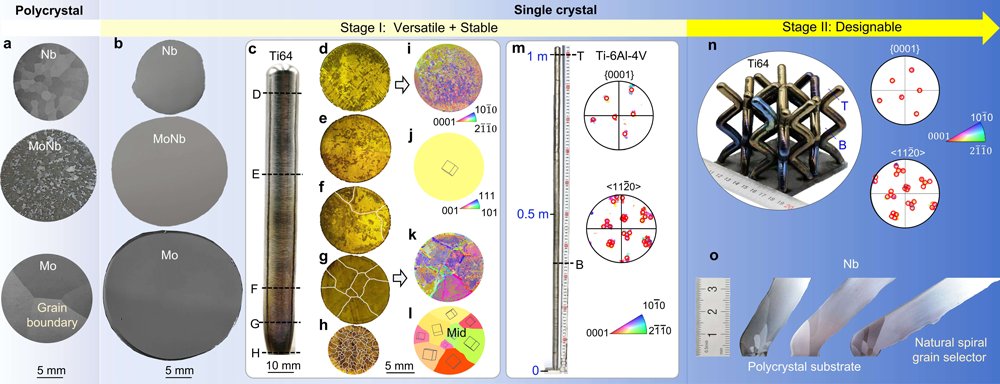
Single crystals have continuous crystallographic orientation without conventional grain boundaries, giving them inherent advantages in high-temperature creep resistance and thermal conduction. Conventional single-crystal parts rely on directional solidification and precision casting, requiring seed crystals and molds. As shapes become more complex, heat flow and crystal orientation are difficult to control.
The team developed a coupled mechanics–solidification theoretical model for additive manufacturing and a printable phase diagram. It proposed a “deep-squat pulse” heat-input method that alternates strong and weak inputs to control melt-pool evolution and dynamically stabilize single-crystal growth under strongly nonequilibrium conditions. Without seed crystals, stray crystals, molds, or additional supports, the researchers grew single crystals directly from a conventional polycrystalline substrate to meter-scale height and centimeter-scale diameter. They also printed a suspended lattice of curved single-crystal rods.
Using Ti-6Al-4V titanium alloy as a model material, the new method produced single crystals with creep resistance an order of magnitude better than conventional wrought and additively manufactured polycrystalline materials, exceeding predictions from conventional grain-size scaling laws. The method was also extended to refractory metals including tungsten, molybdenum, niobium, and molybdenum–niobium alloys, with potential value for advanced nuclear energy and deep-space exploration. The research received support from the National Natural Science Foundation of China and the National Key R&D Program, among others.
Equipment: from 10 parallel arcs to 40
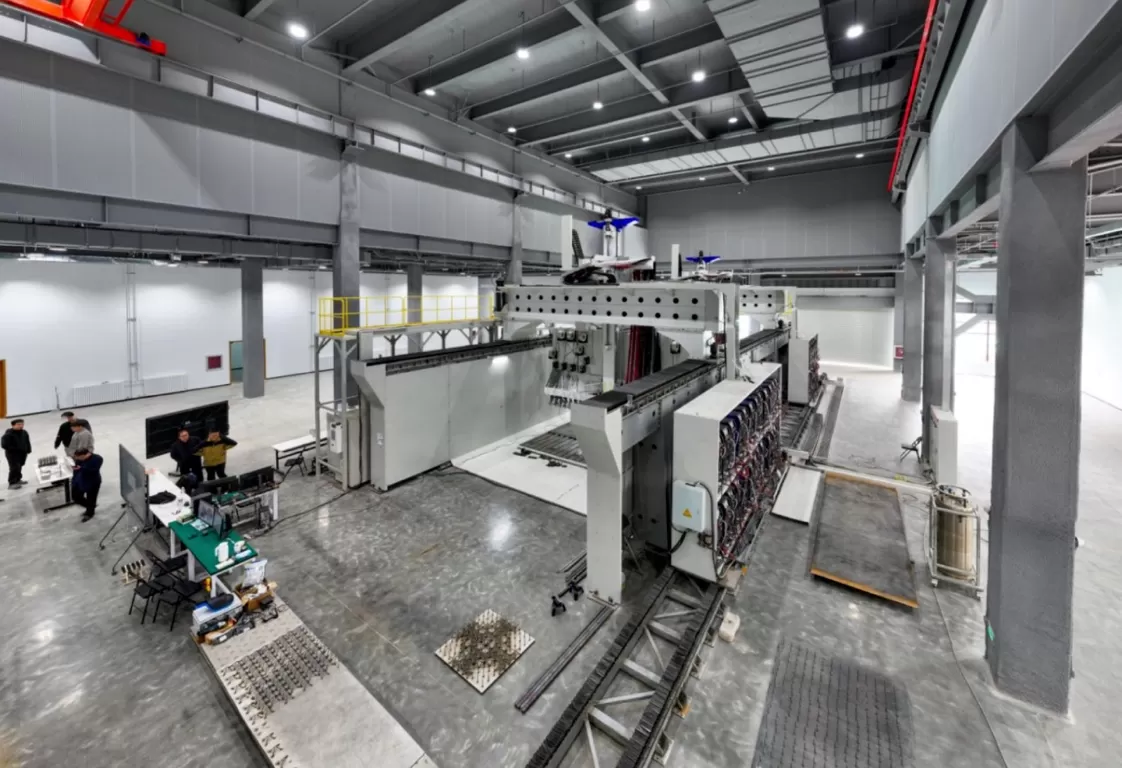
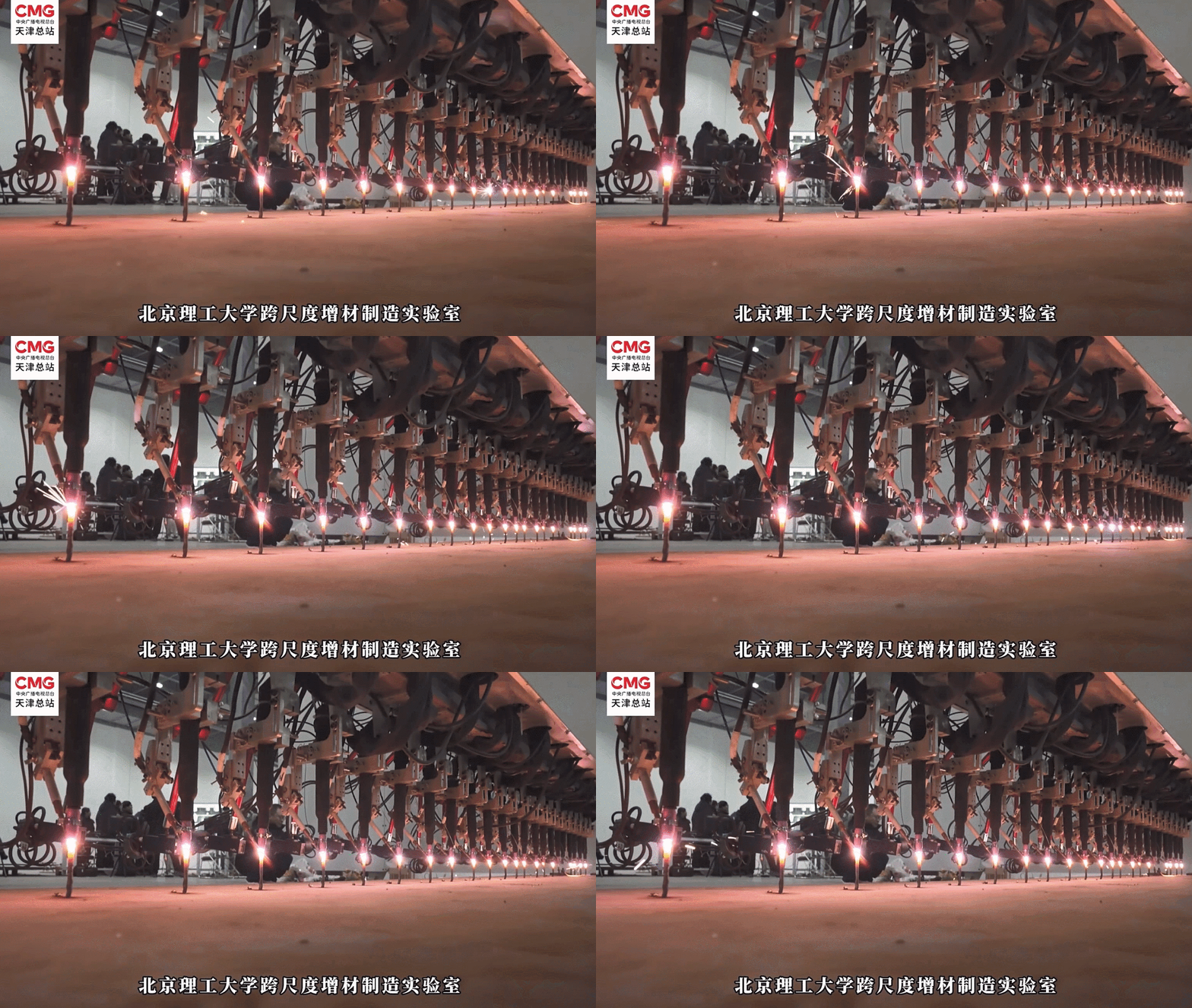
The paper represents a breakthrough in melt-pool metallurgy, but commercialization requires working equipment. The team has built experience in this area for more than a decade. It previously overcame support-free printing of suspended structures and proposed a pulsed-arc-assisted hot-wire freeform process. It independently developed a series of 10-, 16-, and 40-arc parallel 3D printers, enabling 10-meter-class lattice structures and order-of-magnitude improvements in efficiency. This work appeared in 2024 in episode two, “A New Chapter of Shared Success,” of the CCTV documentary on ten years of coordinated development in Beijing, Tianjin, and Hebei.
In January 2025, the team developed a 20-meter-class metal 3D printer with 40 parallel arcs, then extended its manufacturing reach to the 100-meter class through mobile printing. Its equipment now ranges from small single-beam, multi-wire printers to large and ultra-large parallel multi-beam production lines.
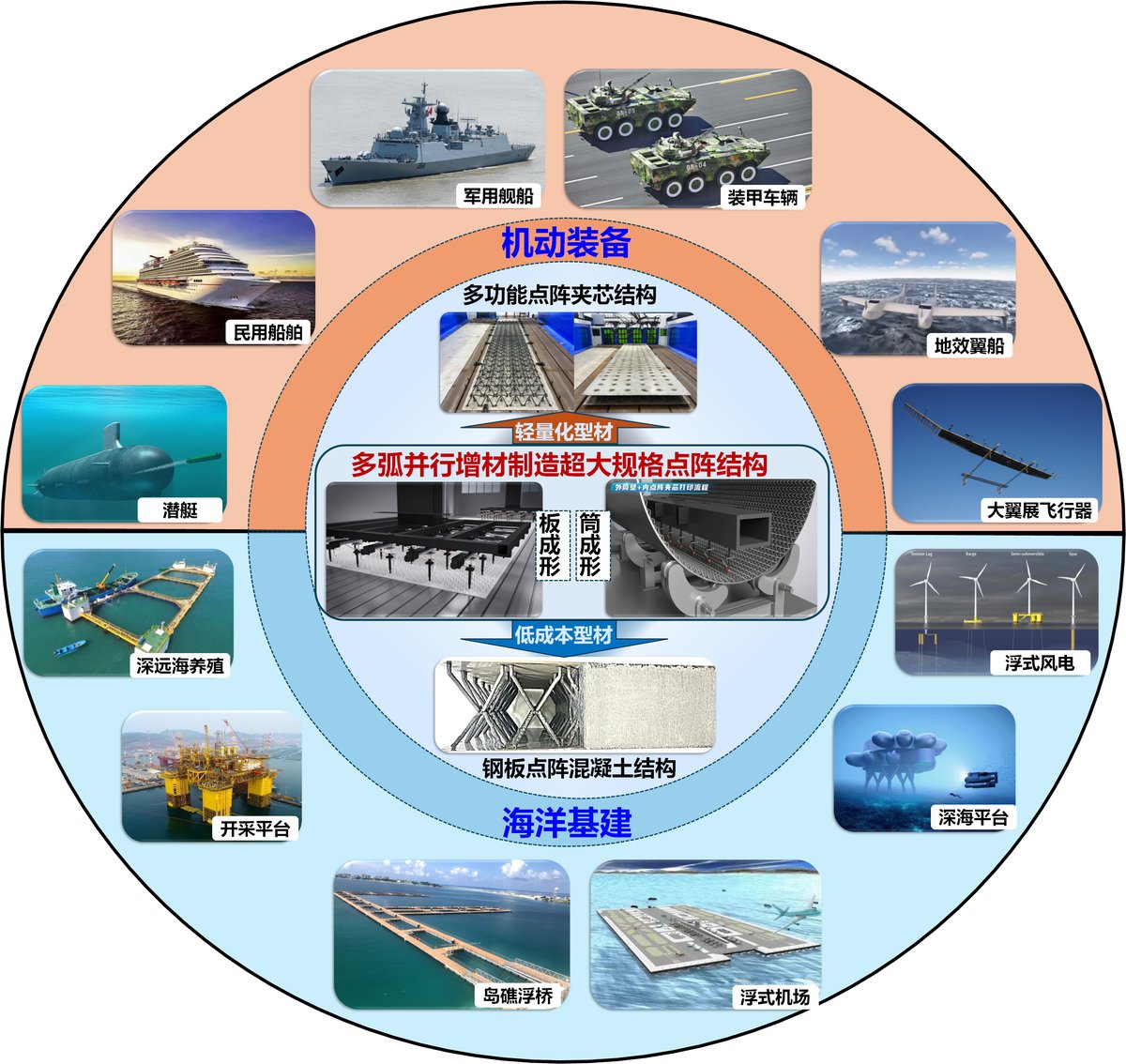
The team has developed two lattice “profile” concepts. One is a lightweight lattice sandwich structure that weighs more than 30% less than conventional structures while providing vibration and noise reduction and blast protection; applications include ships, submarines, armored vehicles, and large-wing-span aircraft. The other is a low-cost steel-plate lattice structure filled with concrete, intended for offshore infrastructure such as floating wind power, deep-sea aquaculture, kilometer-scale floating platforms, deep-sea bases, and island and reef construction.
Deep-sea applications: delivered components are undergoing tests
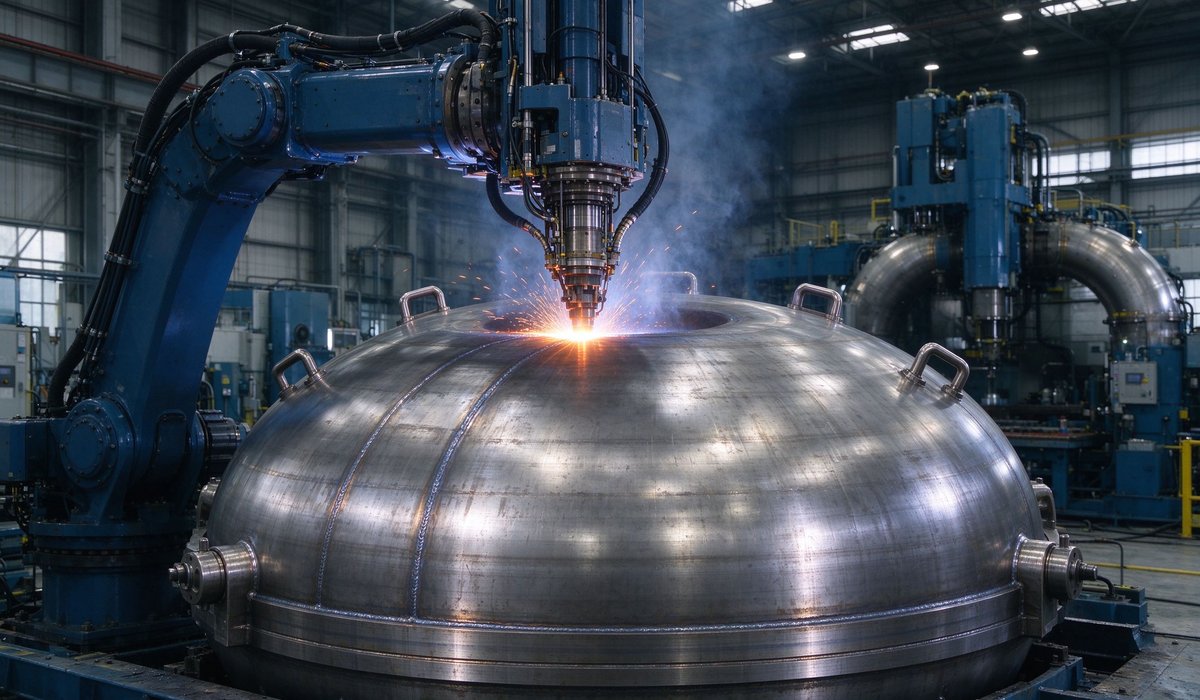
Pressure hulls are among the higher-cost core components of deep-sea equipment. Conventional titanium-alloy forging and welding involves long processes and high costs. Juxing's proprietary “in-situ sponge-titanium additive manufacturing” integrates material and structure in one forming process and reduces manufacturing steps by 90%. According to the company, the pressure-hull cost is reduced threefold relative to conventional forging and welding; a related report describes the resulting cost as one-third of the traditional process.
The company is working with China State Shipbuilding Corporation research institutes on additively manufactured titanium-alloy pressure hulls and with an undersea optical-cable industry partner on titanium-alloy repeater housings. Pressure testing and classification-society certification are progressing.
Lattice sandwich panels for ships and offshore engineering can reduce weight by 30%, cost by 20%, and construction time by 30%. They have completed delivery testing at Guangzhou Shipyard International and are initially being applied to ship superstructures. For deep and offshore waters, floating-platform lattice composite structures made from steel-plate lattices and concrete can reduce platform construction cost and time by about 50%. The company says its first deep-sea platform projects and classification-society certification for 3D-printed ship structures are under way; both remain in progress and depend on later certification results.
What investors see
Guoding Capital said additive manufacturing is a core area of international competition in advanced manufacturing, and that China has long lacked an original, systematic solution for additively manufacturing metal structures above 10 meters. Drawing on more than a decade of BIT team experience, Juxing has built advantages in equipment, materials, and structures simultaneously, making it a relatively rare company in the field. Yunshi Capital pointed to the team's differentiated wire-arc route into ships and deep-sea platforms and its ability to commercialize engineering results behind Nature-level research.
At the policy level, the 15th Five-Year Plan outline lists implementing deep-sea engineering as an important task in the maritime-power strategy. According to PEdaily's incomplete tally, deep-sea companies including Deep Sea Zhiren, Shihang Intelligent, and Gongzhi Marine have raised funding since the start of 2026.
Nanjixiong's observations
The paper addresses the scientific questions of whether a single crystal can grow to meter scale and achieve the necessary performance. The financing addresses the engineering question of whether ultra-large components can be produced at scale for ships and platforms. Together, they show a systematic route from melt-pool metallurgy through equipment to structural designs.
The metal 3D printing narrative is shifting from precise small parts to large and on-site structures. If the approach succeeds, applications could extend beyond shipbuilding to repair and manufacturing of nuclear-power and large energy equipment.
Sources: PEdaily / Tencent News (October 26, 2026, article); Nature paper (October 21, 2026); Tsinghua University News / China Education and Research Network (October 23, 2026); BIT School of Mechanical Engineering (March 6, 2024); Additive Industry paper analysis (October 22, 2026).
AI-generated illustration from the related Chinese report:
AI-translated from an article by Beijixiong on Nanjixiong, originally published on 2026-10-26. Text and images retain the original source attribution.
Read the original Chinese article
Cross-posted copies of the same source content have been consolidated into this article. |



 Record number | ©2024 panda3dp Team. Powered by panda3dp