The 2026 International Additive Manufacturing Technology and Application Ecosystem Exhibition (AMTAE 2026) runs November 26–28 in Hall D of the Luzhou International Convention and Exhibition Center, Sichuan. The official event spans approximately 10,000 m² and focuses on applications and collaboration across equipment, materials, core components and finished applications.
Nanjixiong learned that Shenzhen XTRII-tech will exhibit its industrial metal, continuous-fiber and ceramic 3D printing systems and representative applications at booth DT-21. It will show how its materials, processes, equipment, software and applications work together.


The portfolio covers aerospace, the low-altitude economy, physical AI (embodied intelligence, automotive electronics and computing semiconductors), and energy and chemicals. It addresses demand for lighter, higher-performance parts and digital manufacturing.
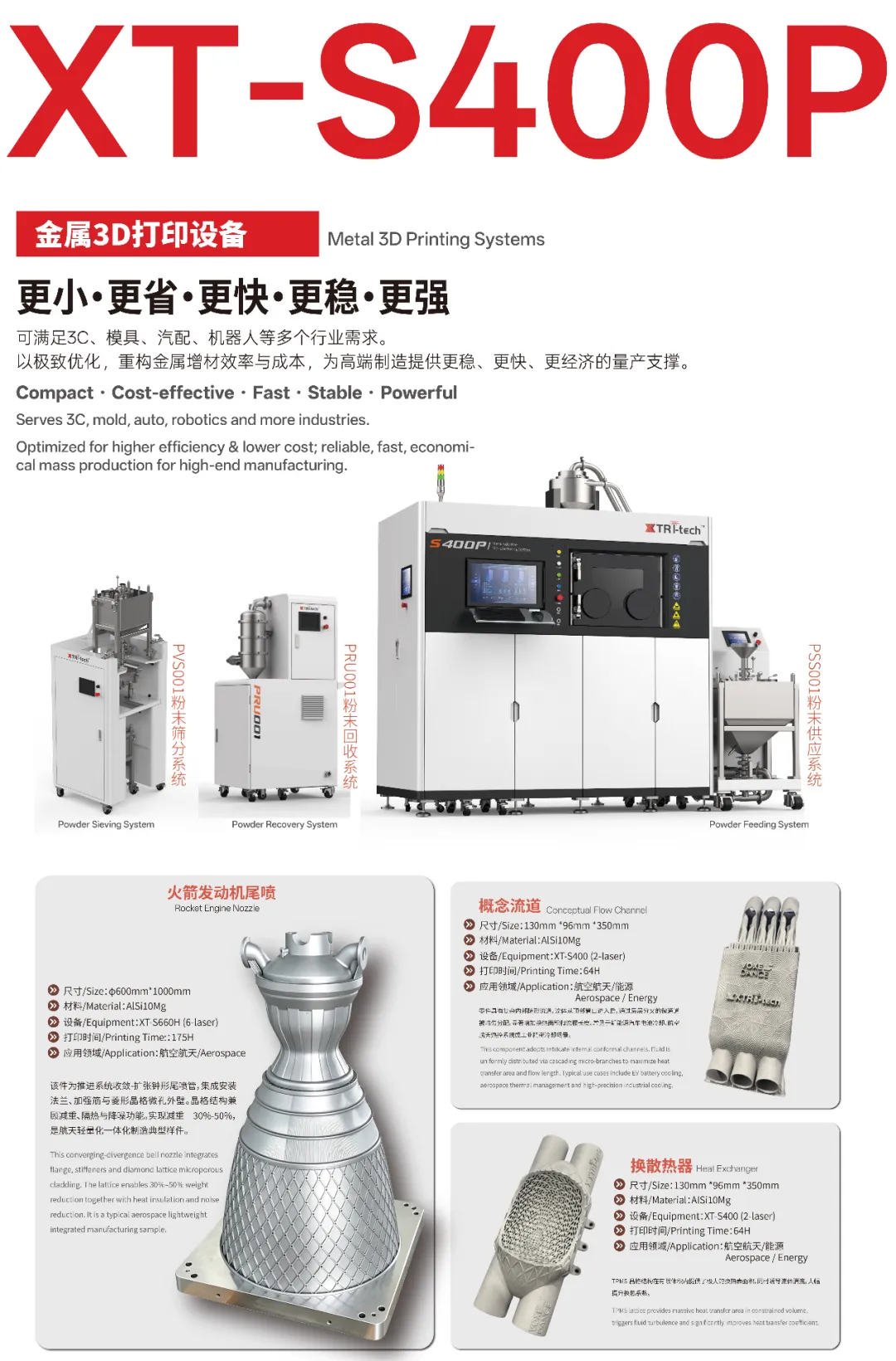
Metal 3D printing: XT-S400P for efficient production
XTRII-tech will show the XT-S400P metal 3D printer. The company emphasizes a smaller footprint, lower cost, faster output, stability and performance for batch production in consumer electronics, tooling, automotive parts and robotics.
Two aerospace examples accompany the machine:
• Rocket engine exhaust nozzle: An AlSi10Mg sample combines an expanding, needle-shaped exhaust geometry and a fine diamond lattice outer wall. The company reports a 30–50% weight reduction, along with noise reduction and thermal insulation.
• Concept flow channels and heat exchanger: An AlSi10Mg sample demonstrates complex internal passages, integrated microchannels and small features. Such designs can increase heat transfer area and induce fluid turbulence to improve heat exchange in aerospace and energy applications.
Continuous fiber printing: YJ-X300-M for embodied intelligence
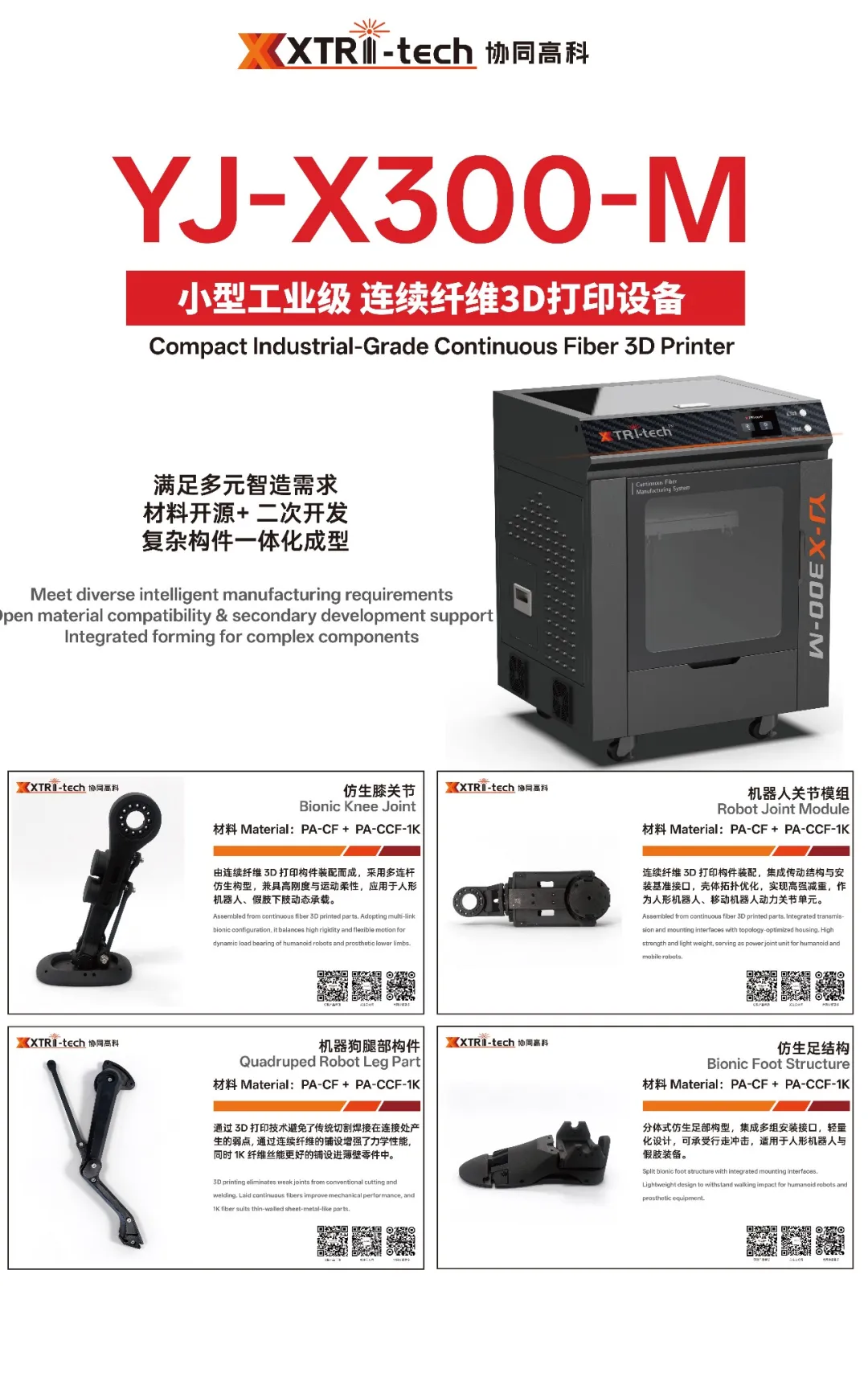
The compact industrial YJ-X300-M uses an open materials platform and supports further development and single-piece builds of complex components.
Robot parts printed with PA-CF and PA-CCF-1K continuous fiber materials include:
• Biomimetic knee joint: A multi-link design combines rigidity and freedom of motion for dynamic loads in humanoid robots and lower-limb prostheses.
• Robot joint module: Integrates the drive structure and mounting interface. Topology optimization reduces weight while retaining strength.
• Robot dog leg and biomimetic foot: Printing eliminates weak joints introduced by conventional cutting and welding, and continuous fibers improve mechanical performance. The lightweight, split foot design withstands impacts during walking.
High-purity alumina ceramics for heat and corrosion resistance
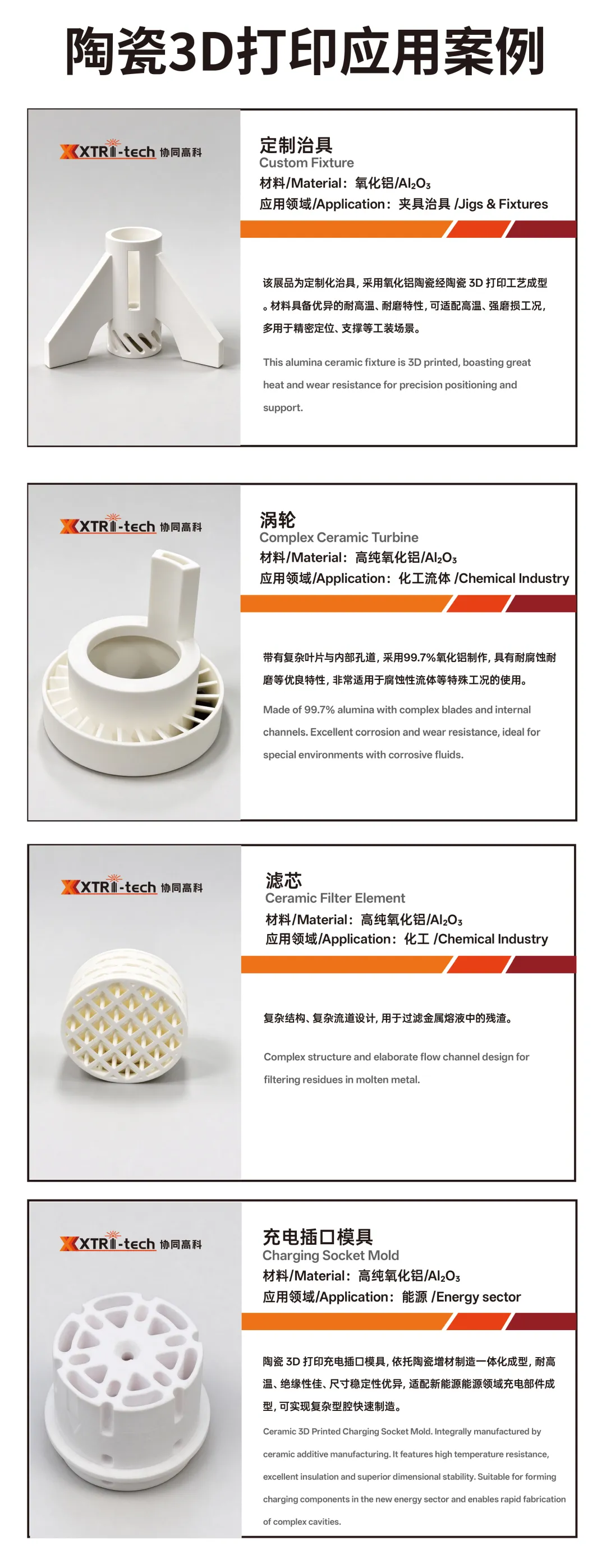
Energy, chemical processing and tooling applications include components made from high-purity alumina (Al₂O₃):
• Complex ceramic turbines and filter elements: Parts made from 99.7% alumina contain complex internal blades and passages. Their corrosion and wear resistance suits demanding operations such as chemical fluid filtration.
• Custom fixtures and charging socket molds: Ceramics offer heat resistance, electrical insulation and dimensional stability. Printing complex cavities quickly and in one piece supports charging component production and precise positioning in high-temperature, high-wear conditions.
An exhibition focused on applications
Additive manufacturing exhibitions often focus on equipment specifications. AMTAE 2026 emphasizes practical applications and collaboration across the supply chain.
XTRII-tech's examples show how equipment and materials work together to solve specific problems, from continuous-fiber robotic feet and high-purity ceramic filters to metal heat-exchange channels for aerospace vehicles.
As low-altitude aviation grows, humanoid robots move toward mass production and commercial spaceflight matures, manufacturers are evaluating how well 3D printing works and how much it costs. XTRII-tech's exhibits across four sectors show how Chinese 3D printing companies are bringing additive processes into advanced manufacturing.
AI-translated from an article by Xiaoruanxiong on Nanjixiong, originally published on 2026-11-16. Text and images retain the original source attribution.
Read the original Chinese article |



 Record number | ©2024 panda3dp Team. Powered by panda3dp